Unit Testing 2
1. Testing Strategy and Bug Data Analysis
- Systematic Approaches: Required to design effective test suites where each case targets different faults.
- Test Strategy: Addresses which test types to deploy and how much effort to devote to each.
- Defect Clustering: Historically, a few modules (error-prone modules) contain the majority of defects found in a system.
- Past Bug Data: Planning test effort should be guided by past detection data, which often shows that reviews and unit tests catch the highest percentage of bugs before release.
2. Unit Testing Fundamentals
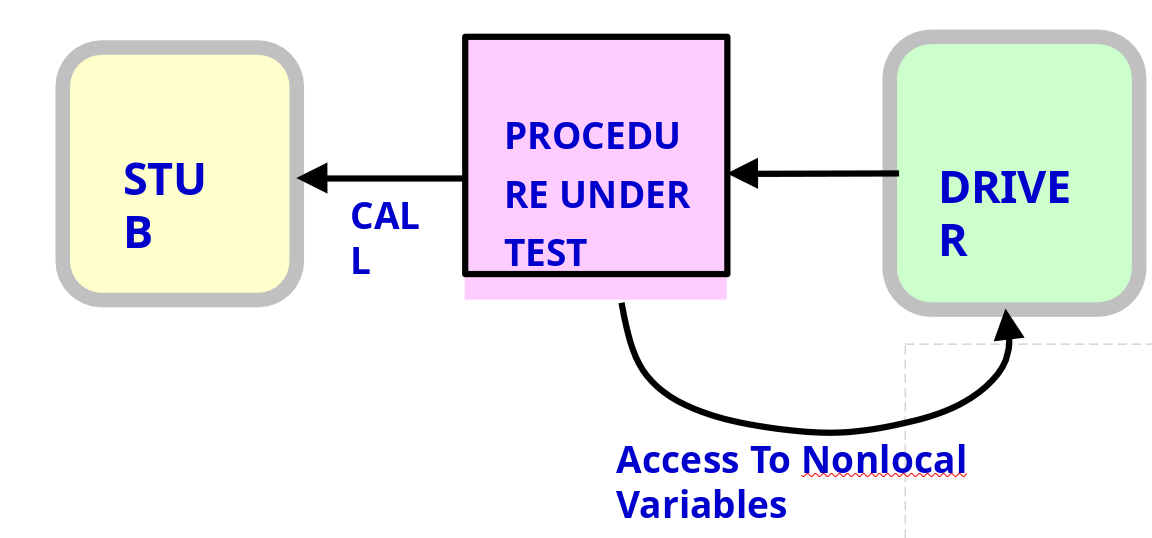
- Definition: Testing individual methods, modules, or classes in isolation after they compile successfully.
- Rationale: Reduces debugging effort substantially; without it, errors become difficult to track down and debugging costs increase.
- Support Structures:
- Driver: Simulates the behavior of a calling function and supplies data to the unit being tested.
- Stub: Simulates the behavior of a function called by the unit that has not yet been written.
- Activities: Unit testing is primarily considered a verification activity.
3. Test Case Design Approaches
- Black-Box (Functional) Testing: Designing cases using only the functional specification without knowledge of internal code.
- White-Box (Structural) Testing: Requires knowledge of the internal code structure.
- Grey-Box Testing: Combines elements of both; testers have limited internal knowledge to design intelligent cases while focusing on the user view.
4. Black-Box Testing Techniques
A. Scenario Coverage
- Derived from Use Cases by identifying the basic flow and all alternative flows.
- Each scenario leads to one or more test cases defined by conditions, inputs, and expected results.
B. Equivalence Class Partitioning (ECP)
- Goal: Partition the input domain into classes where the program is expected to behave similarly for every value in that class.
- Guidelines:
- Range: One valid and two invalid classes (e.g., for range 1–100, classes are <1, 1–100, and >100).
- Set: One valid and one invalid class.
- Boolean: One valid and one invalid class.
- Types of ECP Testing:
- Weak: Uses one representative from each valid class.
- Strong: Covers all possible combinations of valid classes.
- Robust: Includes invalid equivalence classes to test error handling.
Exercise 2
| Range Name | Condition (Days) | Interest Rate | Class Type |
|---|---|---|---|
| Invalid Low | $days \le 0$ | N/A (Error) | Invalid |
| Bracket 1 | $1 \le days \le 15$ | 3% | Valid |
| Bracket 2 | $16 \le days \le 180$ | 4% | Valid |
| Bracket 3 | $181 \le days \le 365$ | 6% | Valid |
| Bracket 4 | $366 \le days < 1095$ | 7% | Valid |
| Bracket 5 | $days \ge 1095$ | 8% | Valid |
| #### Exercise 3 |
| Equivalence Class | Type | Logic | Example Value |
|---|---|---|---|
| Class 1 | Valid | $0 \le L1 \le 20$ | "NITC_Calicut" (Length 12) |
| Class 2 | Invalid | $L1 > 20$ | "ThisStringIsWayTooLongForThisInput" |
| Equivalence Class | Type | Logic | Example Value |
| Class 3 | Valid | $0 \le L2 \le 5$ | "Lab" (Length 3) |
| Class 4 | Invalid | $L2 > 5$ | "Calicut" (Length 7) |
| Equivalence Class | Type | Logic | |
| Class 5 | Valid | $s2$ exists within $s1$ (Match found). | |
| Class 6 | Valid | $s2$ does not exist within $s1$ (No match). | |
| Class 7 | Invalid/Edge | $L2 > L1$ (A longer string cannot be a substring of a shorter one). | |
| #### C. Boundary Value Analysis (BVA) |
- Rationale: Typical programming errors (like using
<instead of<=) often occur at the boundaries of equivalence classes. - Basic BVT: Selects values at the minimum, just above minimum, nominal, just below maximum, and maximum for each input.
- Robust BVT: Adds values just outside the boundaries (below minimum and above maximum).
- Efficiency Formulas (for $n$ independent inputs):
- Basic BVT: Requires $4n + 1$ test cases.
- Robust BVT: Requires $6n + 1$ test cases.
D. Special Value Testing
-
Testing values known to expose bugs based on the tester's experience, such as division by zero, null pointers, or empty data structures.
-
Unit Testing fundamentals
- Types of Testing
- Scenario-based Testing
- Equivalence Class Partition
- Boundary Value Analysis
- Special Value Testing