Applications and Architecture
| Topic | Approximate page / section in Chapter 1 | |
|---|---|---|
| Applications | Section 1.1 “Applications” begins near the start of Chapter 1. In version 6.1 this is around page 5-7. (cs4440.eng.utah.edu) | |
| Requirements — Scalability and Connectivity | Section 1.2 “Requirements” includes “Scalable Connectivity”. This is shortly after the Applications section. In version 6.1, “Scalable Connectivity” is around pages 8-10. (open-cloud.github.io) | |
| Resource Sharing – Multiplexing / Demultiplexing | These are under Section 1.3 “Architecture”, in the sub-section “Multiplexing and Demultiplexing”. That appears around pages 12-13 in version 6.1. (open-cloud.github.io) | |
| Process-to-process communication | The idea of process-to-process (end-to-end) communication comes in the architecture (transport layer) discussion. It appears in Section 1.3 and also in later sections introducing higher layers. Approx pages 13-14 in version 6.1. (cs4440.eng.utah.edu) | |
| Topic | Section | Approximate Page in common edition |
| Signal & Composite Signals; Periodic vs Non-Periodic; Time & Frequency Domain | Data & Signals, first part of Physical Layer chapter | ~ Pages 50-60 (PDF page count in many editions; printed page ~ maybe in 80-90 range depending on edition) (Mauc University) |
| Transmission Impediments (Attenuation, Noise, Distortion etc.) | Later section in Physical Layer (often called "Transmission Impairments") | ~ Pages 70-80 in similar editions (AcadnTechy) |
| - Web pages |
Identifier to locate web pages - Uniform Resource Locator, uses HyperText Transfer Protocol.
- Delivery of streaming audio and video.
- Real-time audio and video
Important
No delay in transmission of data compared to other classes
Scalable Connectivity
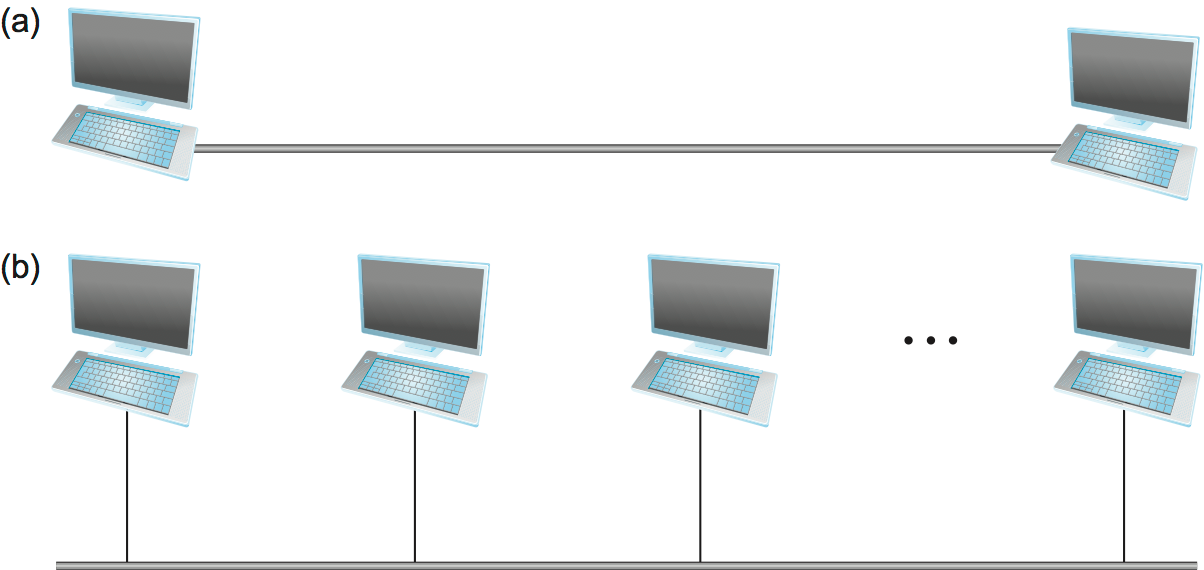
Direct links (a) point-to-point (b) multiple access
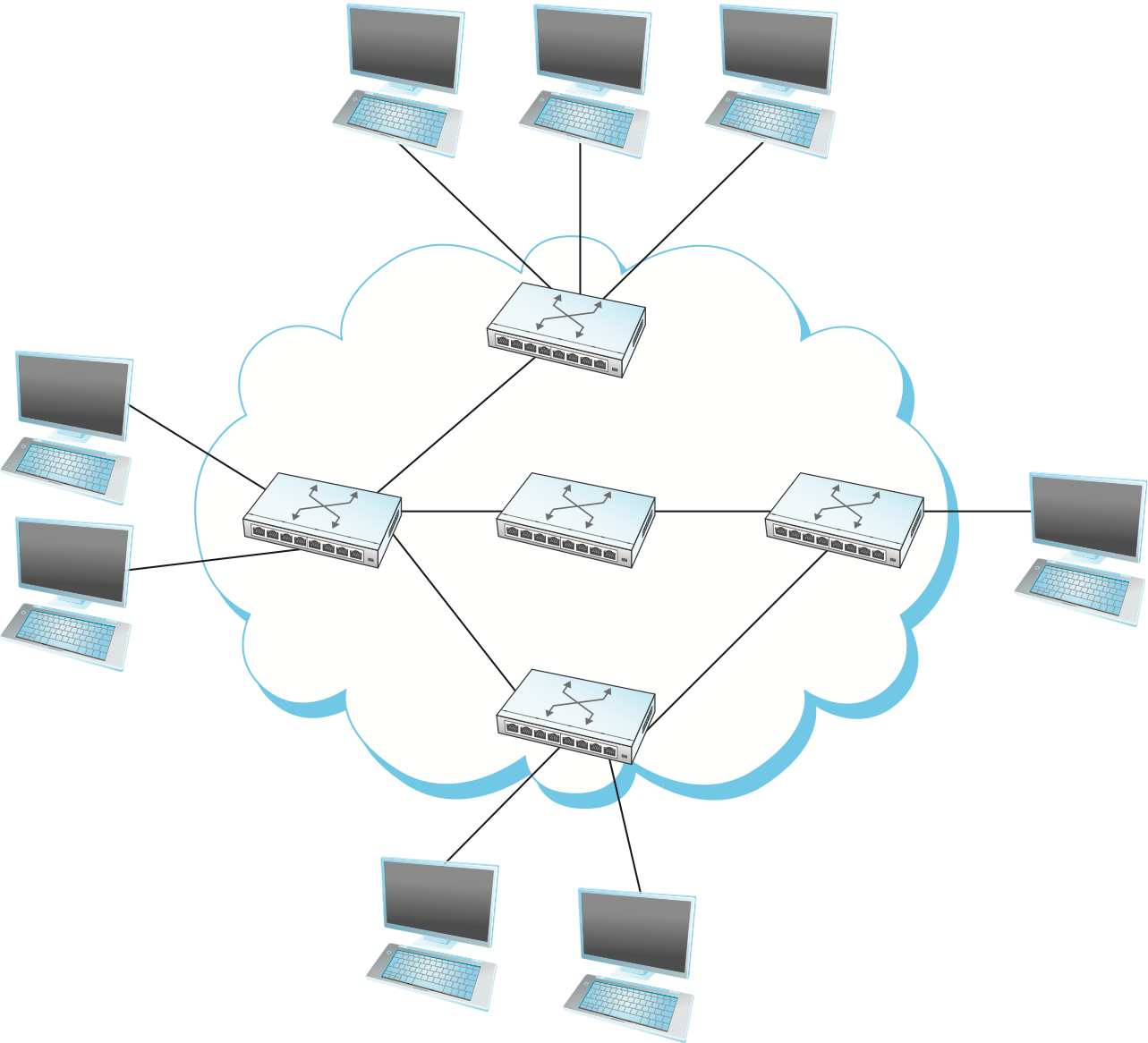
Switched Network
1) Circuit switched - deprecated 2) Packet switched
Detail
Packet-switched networks use a strategy called store-and-forward. Each node waits for the complete packet and then transfers to the next node
- Routing is the process of forwarding messages toward the destination node based on it's address.
Multiplexing
How hosts share a network ?
Multiplexing, which means that a system resource is shared among multiple users.
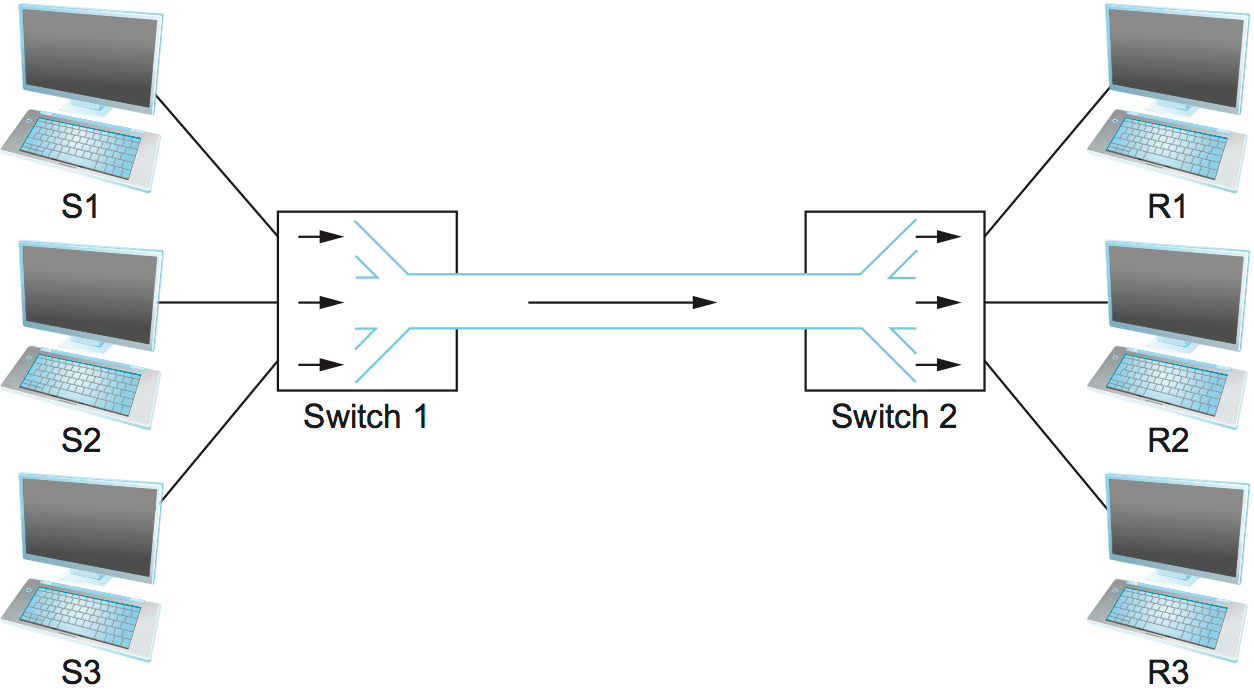
Synchronous time-division multiplexing
Divides time in equal-sized quanta and in round robin fashion, give each flow a chance to send its data over the physical link.
Frequency Division Multiplexing
Transmission of data at a different frequency
Important
Both have its own cons A device has to wait for its turn in STDM Link has to be compatible with multiple frequencies for FDM
Statistical Multiplexing
Like STDM → flows take turns using the physical link Unlike STDM → turns are not fixed, instead, each flow only sends when it actually has data.
This is why packet switching is efficient
Problem
If flows just sent as much as they want, one flow could hog the link The limit is a packet size
In short, statistical multiplexing - packet switching, share the link on demand, use packets to limit how much one flow sends at once.
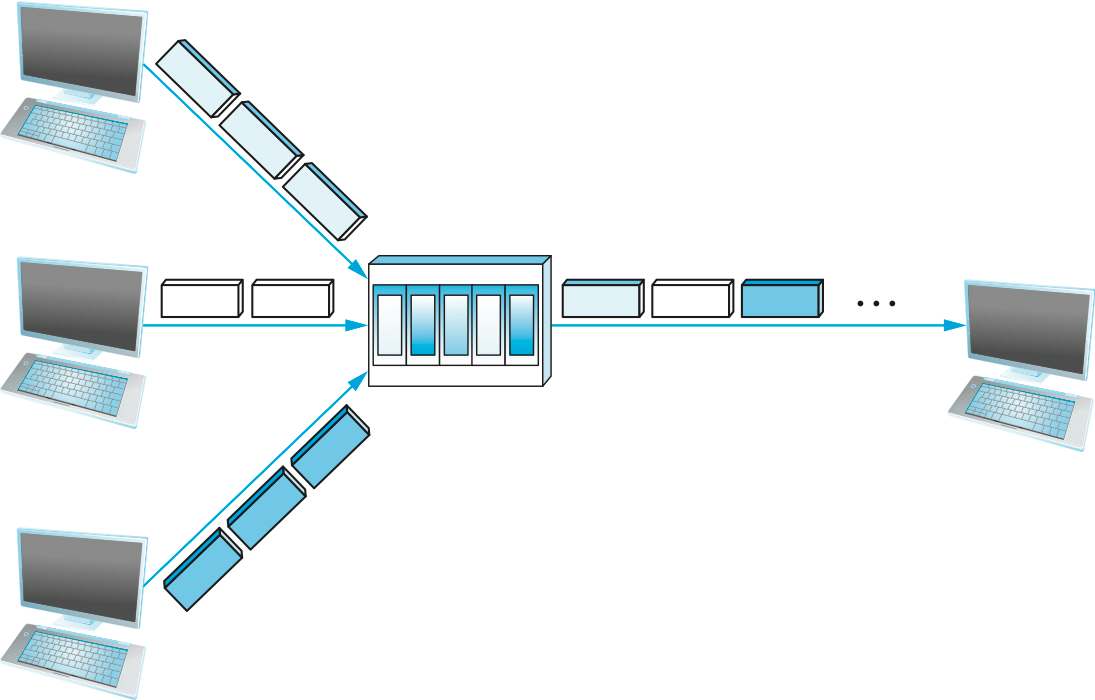
Who makes the decision?
In a switched network, each switch decides which packet to put on its outgoing link. These decisions are local and packet-by-packet FIFO, Round-Robin or Qos (Quality of Service)
Congestion and Buffering
- A switch buffers the extra packets in memory
- If the input rate exceeds output, the buffer fills up
- Once the buffer is full, the switch starts dropping packets.
Communication Patterns
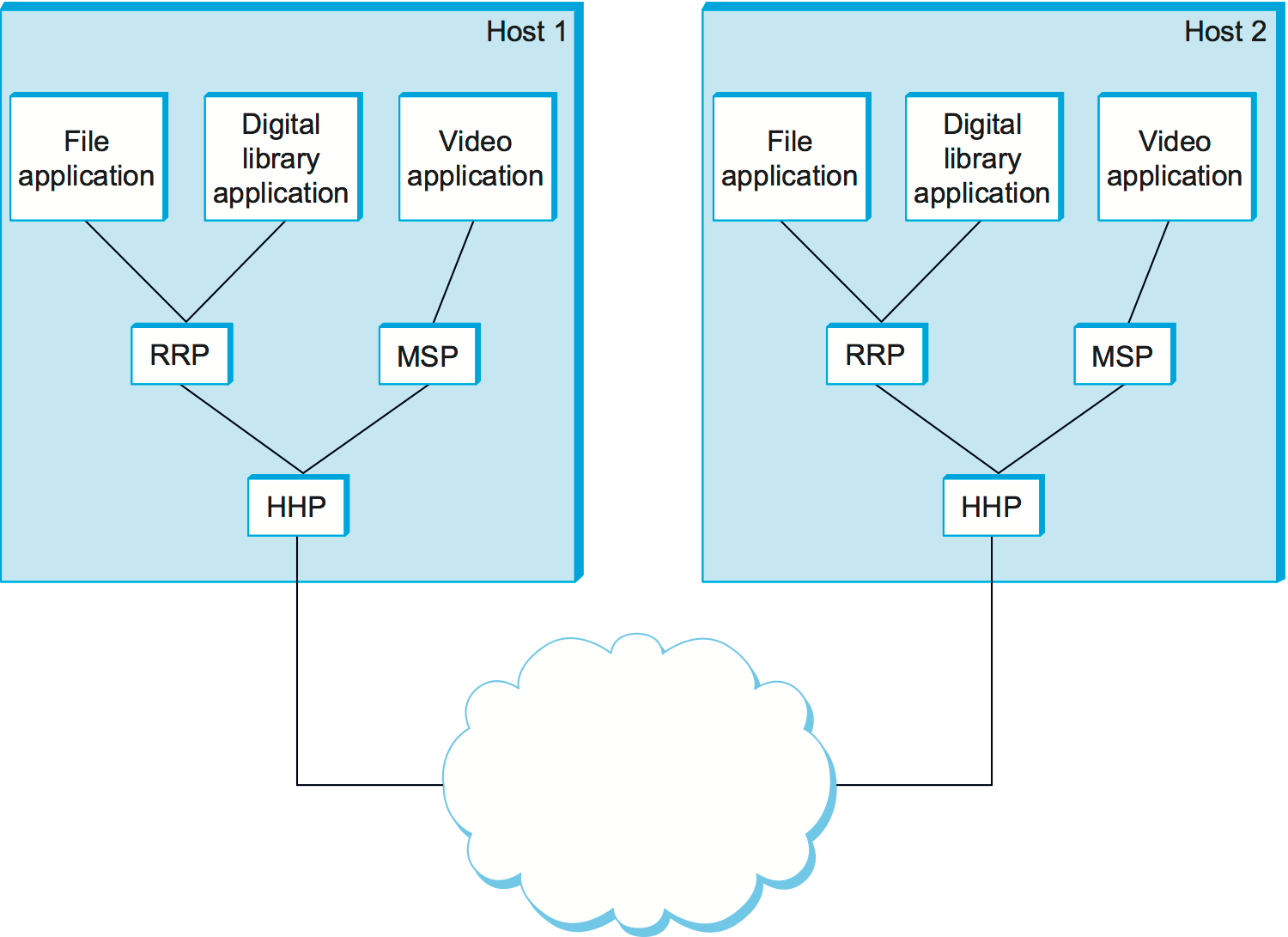
- Request/Reply channel
- Message stream
Errors
- Bit error
- Packet loss
- Node error
Architecture
Guides the design and implementation of networks.
Layering and Protocols
Abstraction - hiding the complexity of the network to the users.
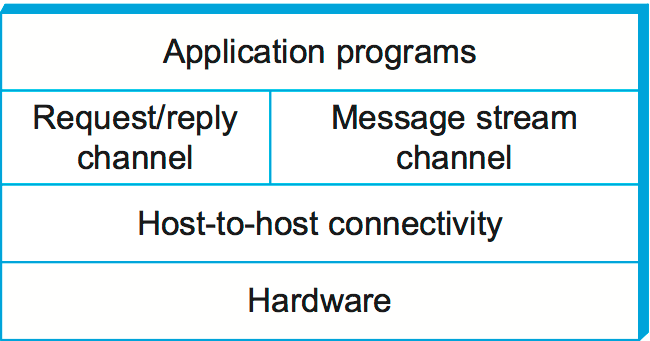
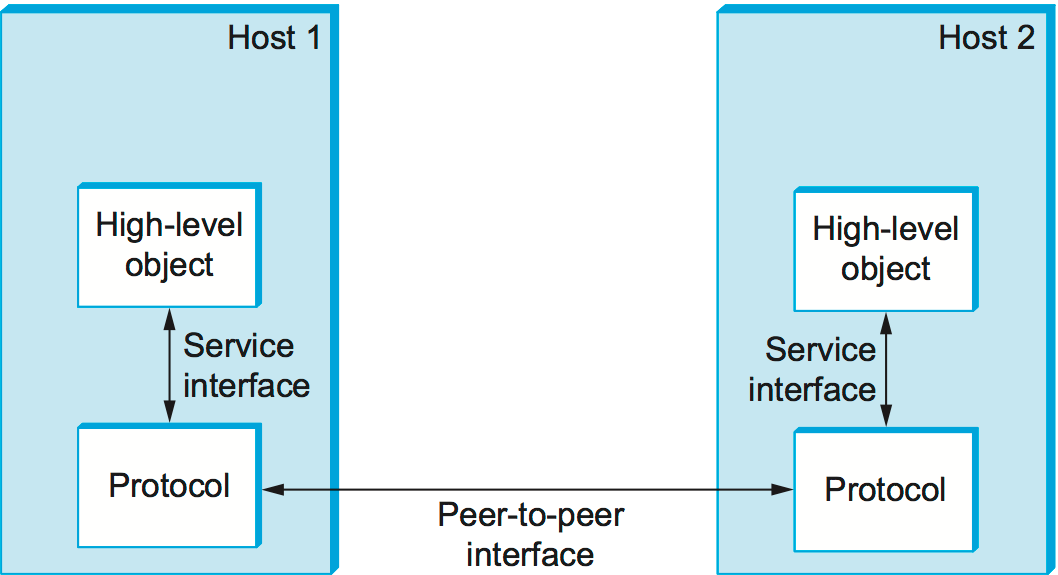
Protocols - set of rules to exchange information, provides a communication service that the higher-level objects use to exchange message.
Each protocol defines two different interfaces.
- Service interface - Defines the operations that the local objects can perform on the protocol. Example, HTTP protocol supports an operation to fetch a page of hypertext.
- Peer interface - Defines the form and the meaning of messages exchanged. Example, HTTP protocol specification defines in detail how a GET command is formatted, the arguments etc.
Encapsulation
Headers (sometimes trailers) are attached to payload at every layer for peer-to-peer communication.
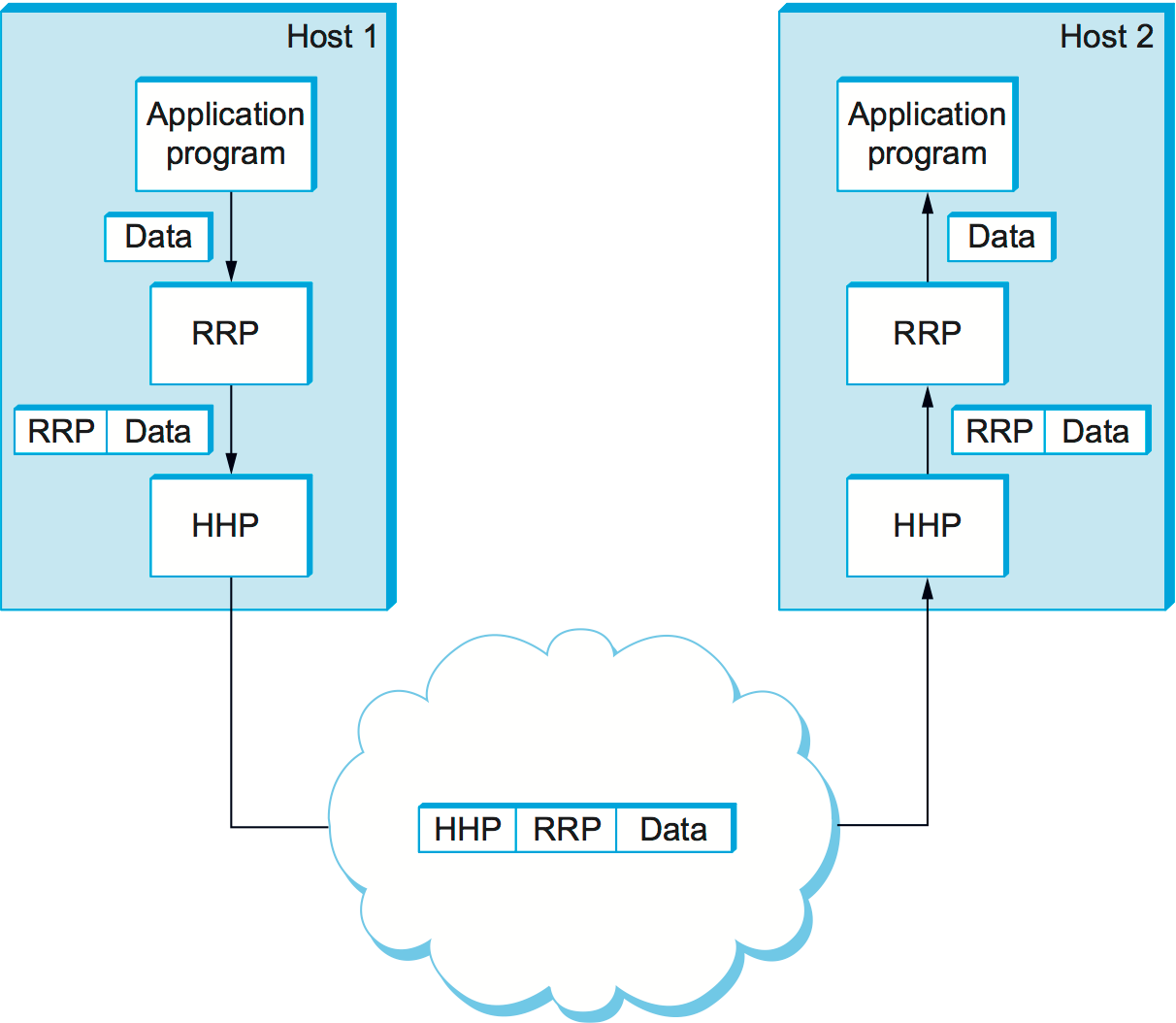
Uses some demux key to interpret where to send the information (Node, application, etc.)
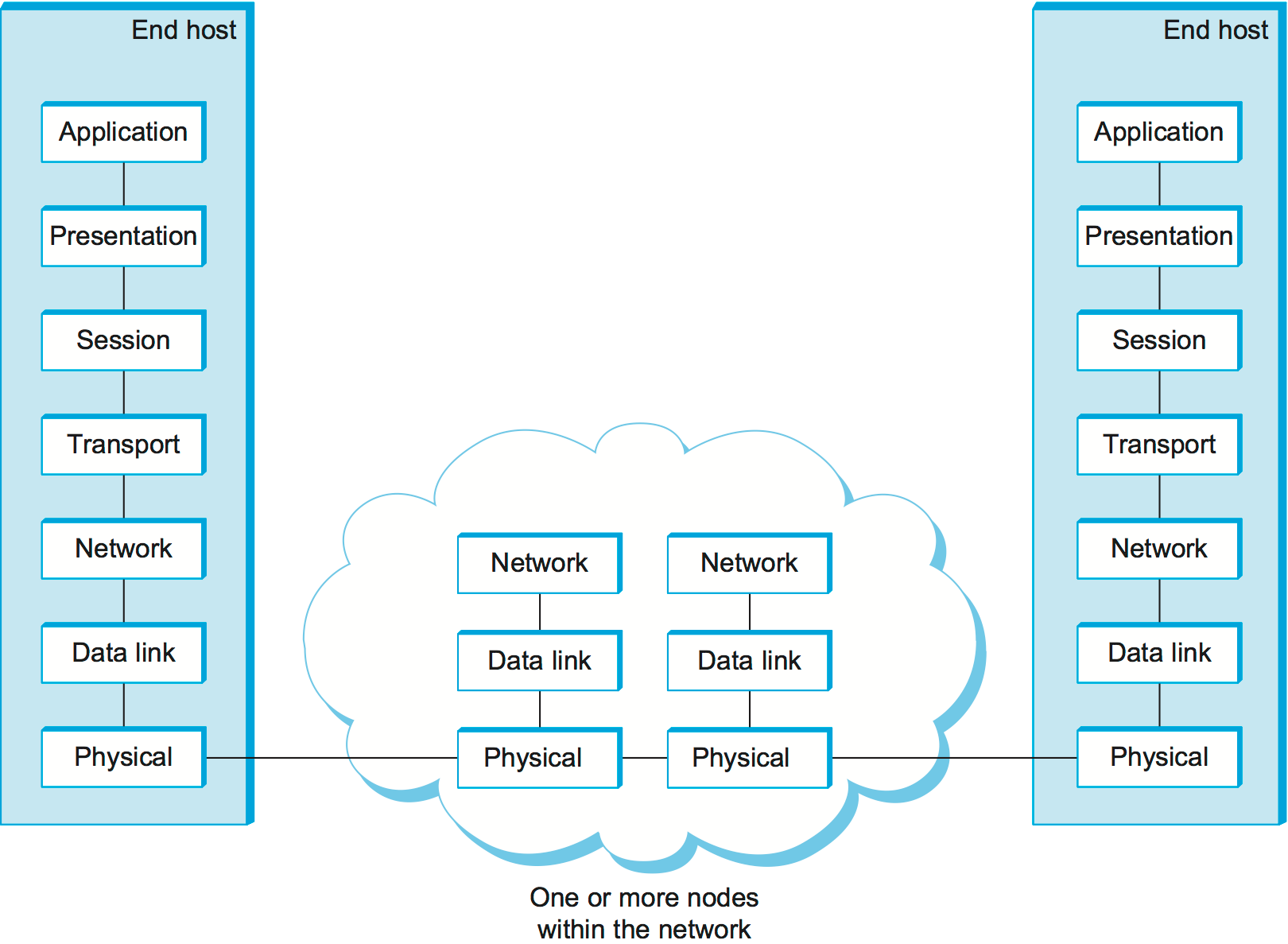
- Data link - Collects a stream of bits into a larger aggregate called a frame. (Network adapters, device drivers).
- Network Layer - Handles routing among nodes within a switched network.
- Transport Layer - Implements what we have up to this point been calling process-to-process channel. Here the unit is actually message.
- Session Layer - Provides a name space to tie together the transport streams that are part of single application.
- Presentation Layer - concerned with the format of data exchanged between peers - whether an integer is 16, 32 etc.
- Application Layer - HTTP etc.
TCP/IP Model
1) Link Layer - Covers ethernet WiFI (802.11), hardware and software combinations. 2) Internet Layer (IP) - Addressing and forwarding system. 3) Transport Layer (TCP/UDP) - TCP and UDP connections. 4) Application - HTTP, FTP, SMTP, SSH, used by applications.