Multiple Access Techniques
- When multiple communications happen simultaneously, others messages can interfere with our communication. Such interference is called noise. To avoid such noise, we use the following techniques
Code Division Multiple Access (CDMA)
- All users use the same frequency and time, but separated by unique codes
- Used in 2G/3G mobile systems and military communications
In this method, we keep a chip sequence. To send a '1' bit, we send this chip sequence, to send a '0' bit, we send the complement of the chip sequence. To transmit 1 bit, we need to transmit 8 bits (practically 64 or 128 bit chip sequence)
Example
Consider there are 4 systems A, B, C and D
The chip sequence of each are
A = 00011011 B = 00101110 C = 01011100 D = 01000010At time t1, let C transmit '1'A = -1 -1 -1 1 1 -1 1 1 B = -1 -1 1 -1 1 1 1 -1 C = -1 1 -1 1 1 1 -1 -1 D = -1 1 -1 -1 -1 -1 1 -1In CDMA, - 1 means '1' bit transmission - -1 means '0' bit transmission - 0 means no transmission Therefore, these chip sequences can be rewritten asS1 = C = -1 1 -1 1 1 1 -1 -1At time t2, let B and C transmit '1'S2 = B + C = -2 0 0 0 2 2 0 -2At time t3, let A transmit '1' and B transmit '0'S3 = A + B' = 0 0 -2 2 0 -2 0 2At time t4, let A and B transmit '1' and C transmit '0'S4 = A + B + C' = -1 -3 1 -1 1 -1 3 1Consider, I am D and I am communicating with C, and all other signals are just noise to me. I just wanna know what C is speaking. For that, we take dot product of the signal I receive with C's chip sequence At time t1,
S1.C = (1 + 1 + 1 + 1 + 1 + 1 + 1 + 1) / 8 = 1=> C transmitted '1' At time t2,S2.C = (2 + 0 + 0 + 0 + 2 + 2 + 0 + 2) / 8 = 1=> C transmitted '1' At time t3,S3.C = (0 + 0 + 2 + 2 + 0 - 2 + 0 - 2) / 8 = 0=> C transmitted nothing At time t4,S4.C = (1 - 3 - 1 - 1 + 1 - 1 - 3 - 1) / 8 = -1=> C transmitted '0'
In this way, we can filter out the required data from the noise
Frequency Division Multiple Access (FDMA)
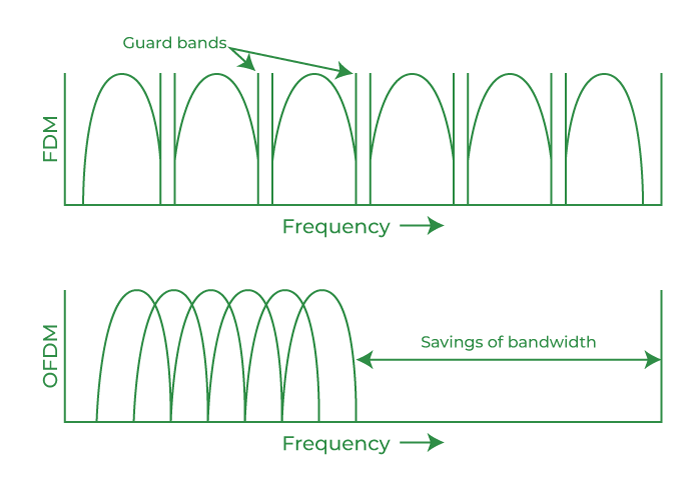
- Each station is given different frequency range.
- Guard band prevents overlapping
- The allowed frequency band will be equally split to all the devices
- Devices can communicate simultaneously
Time Division Multiple Access (TDMA)
- Same frequency spectrum is given to all the devices
- But each device is allotted different time interval
- A device can communicate only in its allotted time
- Every station gets the complete bandwidth
- Time is allotted in Round Robin fashion
Statistical Time Division Multiple Access (STDMA)
- Similar to TDMA
- Difference is in the fact that, the time allotted for a device is dynamically calculated based on the traffic for each station
Orthogonal Frequency Division Multiplexing (OFDM)
- When one station is using the peak frequency, the other will be at zero
- Used in phones
Difference between FDMA and OFDM