Disk contains 8192 blocks each has a size of 2048 bytes, total 16MB
Block allocation map tells whether a block is empty is empty or not → 4 blocks for BAM
0-3 → Block allocations Map
4 → Relation Catalog
5 → Attribute Catalog
Rest -> Relations
Since the first four blocks of the disk are used for storing the Block Allocation Map, the first four entries in the Block Allocation Map are marked as occupied by setting the values to BMAP. This is done when the XFS interface command of fdisk is executed to generate the disk file. Marking of block 4 and block 5 as REC type in Block Allocation Map is also done during the fdisk command.
Relation Catalog (Relation Catalog is also a relation)
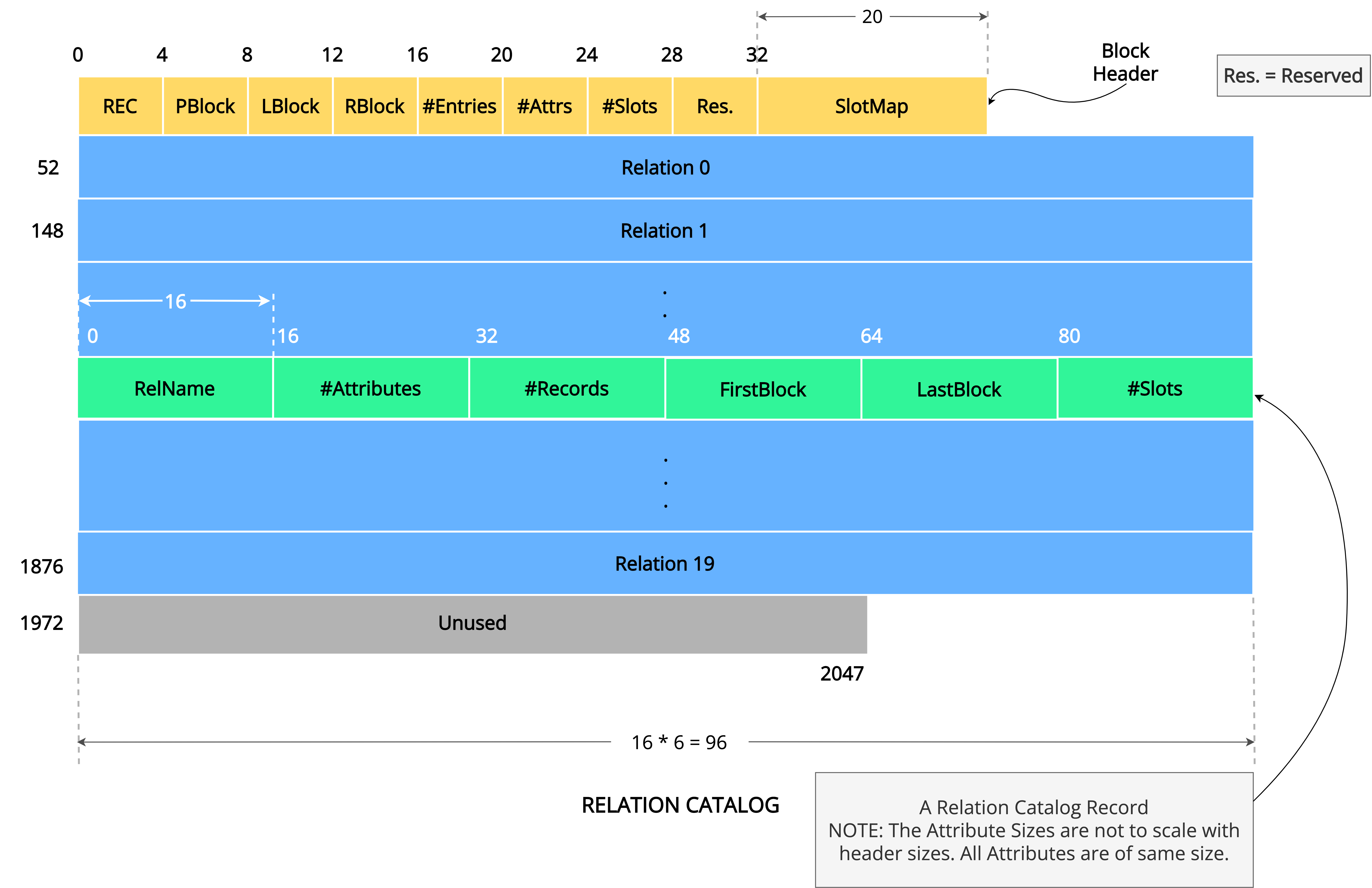
Relation Catalog is used to store the meta information of relations → 96 bytes
Relation, # Attributes, # Records, First Block, Last Block, # Slots (Remember all retarded facts about relation’s location)
Relation → Stores the name of the relation
Note → Record Blocks of a relation are arranged using linked list
Number of slots = 20
Minimum number of records = 2 (For relation and attribute catalog)
Maximum number of records = 18 (20 - 2)
Attribute Catalog (Attribute Catalog is also a relation)
- Relation Name
- Attribute Name
- Attribute Type
- Primary Key
- Root Block → Root block number of the B+ tree used for indexing, else -1
- Offset
Minimum 12 entries require (Attribute Catalog + Relation Catalog)
Record Block Structure (Important)
Each block in a linked list is called record block.
Block1 → Block2 → Block3 → …
In addition to actual data, some header is also stored with the block.
4 Bytes each metainformation
- Type of record block (REC, IND_INTERNAL, IND_LEAF)
- Parent block (-1 for RECORD blocks)
- Left Block
- Right Block
- Number of Records (enteries)
- Number of Attributes
- Number of slots
- Slot Map → Indicates whether a slot is empty or not (SLOT_OCCUPIED OR SLOT_UNOCCUPIED)
- Number of slots = maximum number of records (L)
$32 + L + (16 * K)* L <= 2048$
$L = 20$
Each Record Block is divided into variable size slots → each slots have a record generally.
Block Structure
| Metadata (Header) | Record 1 | Record 2 | ... | Record N | Slot Array (Optional) |
Disk Class
class Disk {
public:
    Disk();
    ~Disk();
    static int readBlock(unsigned char *block, int blockNum);
    static int writeBlock(unsigned char *block, int blockNum);
};
Disk → Used to make a temporary copy of the disk contents before the starting of a new session. This ensures that if the system has a forced shutdown during the course of the session, the previous state of the disk is not lost.
~Disk → To make sure the changes are saved on graceful goddamn exit
readBlock → To transfer contents of the block onto the input memory buffer
writeBlock → To transfer contents of input memory buffer to the block
int main(int argc, char *argv[]) {
  Disk disk_run;

  unsigned char buffer[BLOCK_SIZE];
  Disk::readBlock(buffer, 7000);
  char message[] = "hello";
  memcpy(buffer + 20, message, 6);
  Disk::writeBlock(buffer, 7000);

  unsigned char buffer2[BLOCK_SIZE];
  char message2[6];
  Disk::readBlock(buffer2, 7000);
  memcpy(message2, buffer2 + 20, 6);
  std::cout << message2;

  return 0;
}