Adversarial Search
- Sequence of moves to play
- Rules that specify possible moves
- Rules that specify a payment for each move
- Objective is to maximise your payment
Games as Adversarial Search
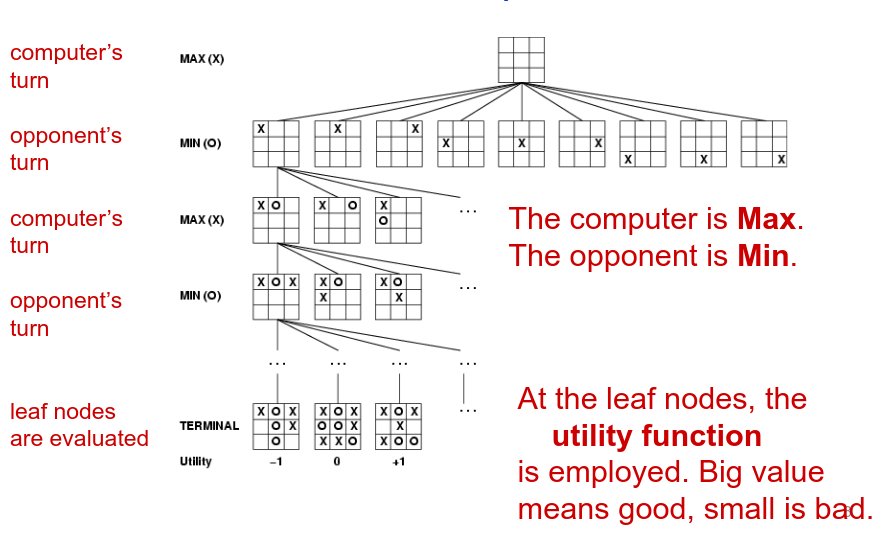
- States
- Initial state
- Successor function
- Terminal test
- Utility function
Minimax
Minimax and Alpha-Beta Pruning
Properties
- Complete (yes, if the tree is finite)
- Optimal (Yes, against an optimal opponent)
- O(b^m) - Time Complexity
- O(bm) - Depth-first exploration
alpha - The highest score that the computer is currently guaranteed to achieve at the current node or any higher level.
beta - The best score that the minimising player is guaranteed to achieve
-
Good Case (Ordered First): If the best move is analyzed first, the "Beta" value drops (or "Alpha" rises) immediately. This creates a very narrow window, causing almost all subsequent moves to be pruned because they are worse than the one already found.
-
Bad Case (Worst Moves First): If you analyze the worst moves first, the window remains wide open. The algorithm must process every single branch to ensure it hasn't missed a better option, effectively turning Alpha-Beta back into standard Minimax.
with perfect ordering - O(b^m/2)
Normal - T(m) = bT(m-1) Perfect - T(m) = T(m-1) + (b-1)T(m-2)
Cutting Off Search
- Cutoff instead of Terminal
- Eval instead of Utility
Evaluation Functions in Tic Tac Toe
f(p) =
- Largest positive number if p is a win for computer
- smallest negative number if p is a win for opponent
- RCDC - RCDO
function evaluateBoard(board) {
    // 1. Identify all 8 winning lines (3 rows, 3 cols, 2 diags)
    const lines = [
        [0,1,2], [3,4,5], [6,7,8], // Rows
        [0,3,6], [1,4,7], [2,5,8], // Cols
        [0,4,8], [2,4,6]           // Diags
    ];

    let rcdc = 0;
    let rcdo = 0;

    lines.forEach(line => {
        const symbols = line.map(index => board[index]);

        // Computer (X) can win if there are no O's in the line
        if (!symbols.includes('O')) rcdc++; [cite: 396]

        // Opponent (O) can win if there are no X's in the line
        if (!symbols.includes('X')) rcdo++; [cite: 396]
    });

    return rcdc - rcdo; // f(p) [cite: 207]
}
Samuel’s Checker-Playing Program
f(n) = w1f1(n) + w2f2(n) + …
- K = King advantage
- M = Man advantage
- U = Undenied Mobility Advantage
In learning mode
- A adjusts its coefficients after every move
- B uses the static utility function
- If A wins, its function is given to B
Horizon Effect
Solutions
- Do not cut off search at non-quiescent board positions (check until stable nodes) (Quiescence Search)
- Search further down selected path to ensure this is the best move
Other Solutions
- Probabilistic cut of branches (assuming that deeper search wont change the outcome)
- Openings and Endgames
- Singular Extensions
Other Games
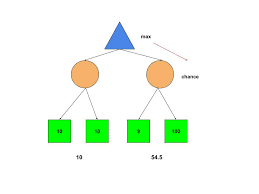
- Use Expetiminimax, which introduces a change node
- Time complexity - O(b^mn^m)