MAC Protocols
- For a shared medium with multiple nodes
Random Access Protocols
- Randomly sends the data from any node
- Eg. ALOHA (Slotted/Pure), CSMA, CSMA CD (Detection)/CA (Avoidance)
Channelisation
- Use of multiplexing to send the data
- FDMA, TDMA
Pure Aloha
- Random Access Protocol
- Collision is possible (maybe another station is also transmitting data)
- Acknowledgement is there, re transmission is possible
- Vulnerable time = 2 * Transmission time
- Efficiency = G * e ^ -2g, G -> No of stations
- Max efficiency = 18.4%
Slotted Aloha
- Divided into slots of transmission time
- Only transmission at the begin of the stot
- Vulnerable time - Transmission time
- Efficiency = 36.8 %
Carrier Sense Multiple Access Protocol
1) 1 - Persistent - Continuously sensing the channel, once free it sends the data (collision) 2) 0 - Persistent - If the channel is busy, it backs off for some time (loss of bandwidth) 3) P-Persistent - Continuously sensing the channel, starts the probability of p (hybrid)
- Sensing the carrier for any transmission in the medium in the meantime
- Checks only the point of contact only, not the entire channel
Carrier Sense Multiple Access Protocol / CD
- Used in Ethernet
- How to check if the frame has been collided?
- Senses collided frame while the station is transmitting the frame.
- No acknowledge system
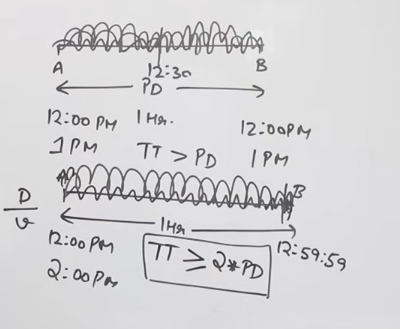
- Transmission Time > Propagation Delay (Max - TT >= 2 * Transmission Time)
- Efficiency = 1 + /1 + 6.44a, a = PD/TT