Random Medium Access Control
CSMA Protocol
- Carrier Sense Protocol
- Increases performance
- Chances of collision exists because of propagation delay. Because a frame sent by a station may not be received, causing the medium to be "free".
1 - Persistent CSMA
- If the channel is busy, listen continously until it becomes free, then transmit immediately.
Non-Persistent CSMA
- If the channel is busy, back off and wait a random amount of time before trying again.
- Might lead to lower channel utilisation. If the random backoff time is long, the channel might sit idle even though a station is ready to transmit.
P-Persistent CSMA
- If the channel is busy, wait until it is free. When it is free, transmit with a certain probability. Once the channel is idle, it transmits with a probability p
- Basically randomising the the decision to transmit.
- After first collision, they get to choose a re transmission time between 0-1
- After each collision, the window size increases exponentially 2^k-1.
CSMA/CD
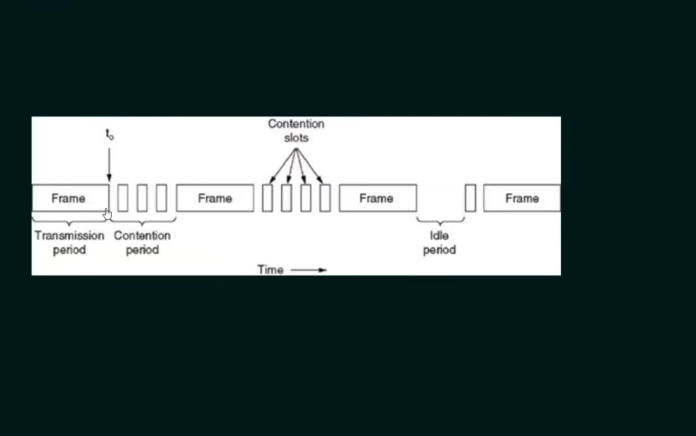
- If two stations sense the channel to be idle and begin transmitting simultaneously they will both detect the collision almost immediately.
- Rather than finishing transmitting their frames, they should abruptly stop transmitting as soon as the collision is detected.
- Saves time and bandwidth.
- Has alternating contention and transmission periods, with idle periods occuring in between.
Collision
We can detect collision if Transmission Time > 2 * Propagation Time