Substitution and Transposition ciphers CaesarCipher, Vernam cipher Advantages anddisadvantages
DES
- Data Encryption Standard (DES) was the widely used encryption scheme.
- It was designed based on a structure called a Feistel Network, which allows the hardware/software logic to be used for both encryption and decryption.
- Algorithm Type: Symmetric
- Key Size: 56 bits
- Rounds: 16 rounds of processing
- 64 bit blocks
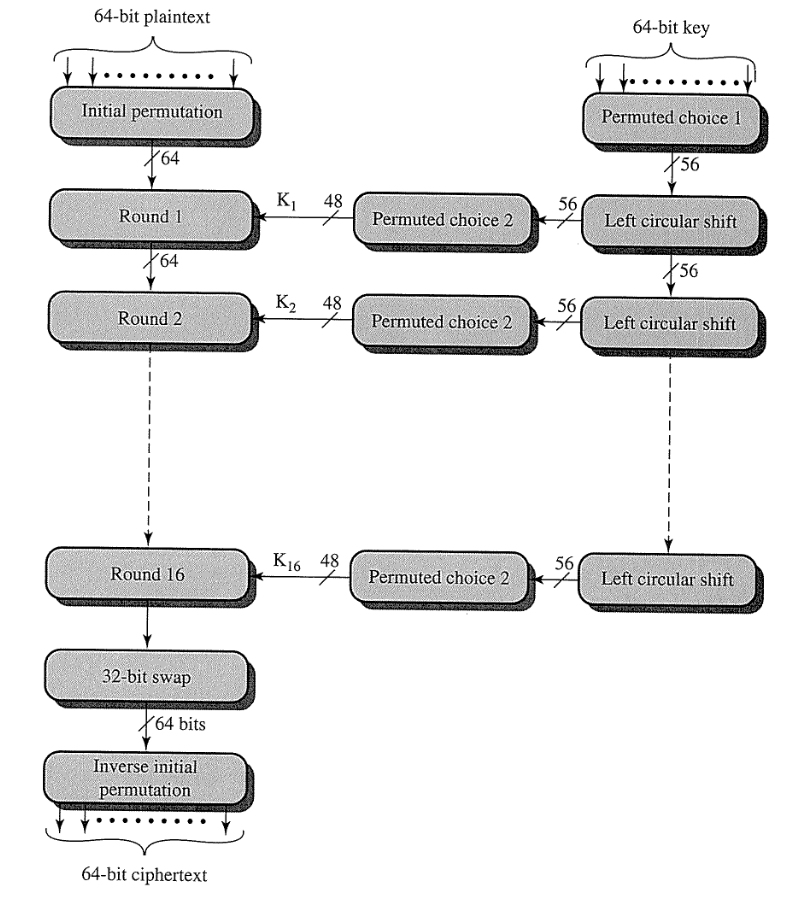
Decryption
- Same process, application of subkeys is reversed, and the initial and final permutation functions are reversed as well.
Disadvantages
Small Key Size: 56 bits provide 2^56 possible combinations. While this seemed huge in 1977, modern computers (and specialized "DES Cracker" hardware) can brute-force the entire key space in just a few hours.
Caeser Cipher
It is a substitution cipher where each letter in the plaintext is replaced by a letter a fixed number of positions down the alphabet.
Encryption: En(x)=(x+n)(mod26) Decryption: Dn(x)=(x+n)(mod26)
Advantages - Extremely fast because of simple substitution. Security: Extremely low. There are only 25 possible keys (excluding a shift of 0), making it trivial to break via brute force or frequency analysis.
Vernam Cipher
- Assign a number to each character of the plain text and the key according to alphabetical order.
- Bitwise XOR both the number (Corresponding plain-text character number and Key character number).
- Subtract the number from 26 if the resulting number is greater than or equal to 26, if it isn't then leave it.
Highly Secure, But waste of space for key
Avalanche Effect
”Any small change to input or key must bring significant change to the cipher text”
Substitution → change of characters Transposition → change in position of characters