Interface between user and the hardware is called operating system. Job of the operating system is to provide the user programs with a better, simpler, cleaner model of the computer and to handle managing all the resources just mentioned Kernel is a component of the os that manages the hardware resources and serve as the middle ground between applications and hardware
- Process Scheduling and Process synchronization
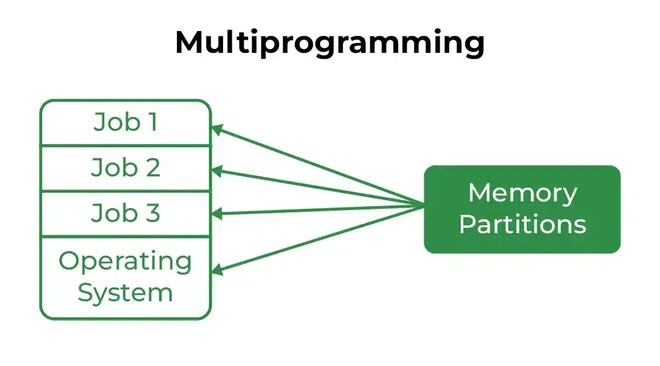
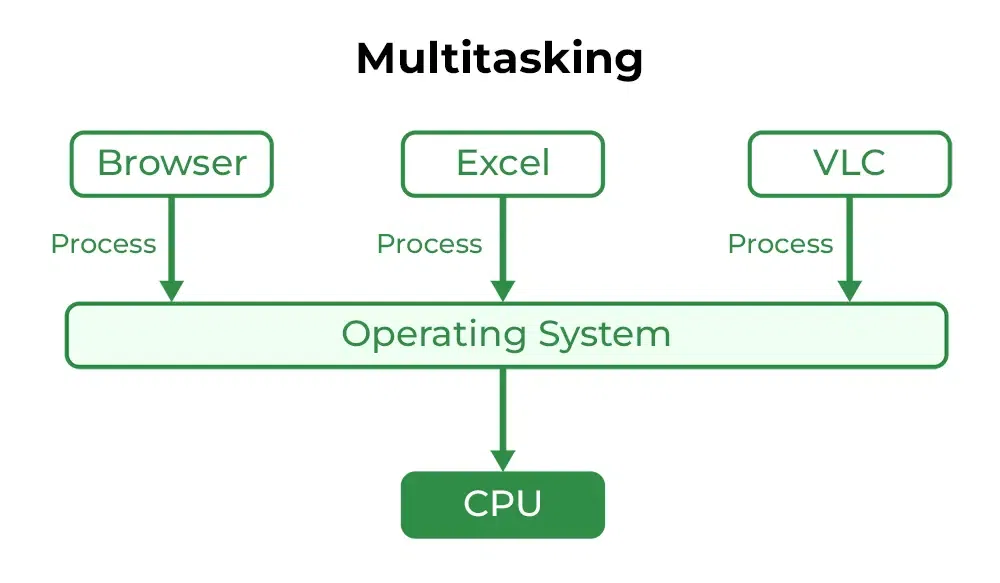
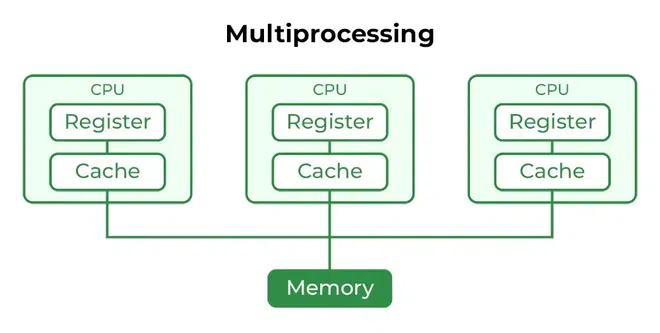
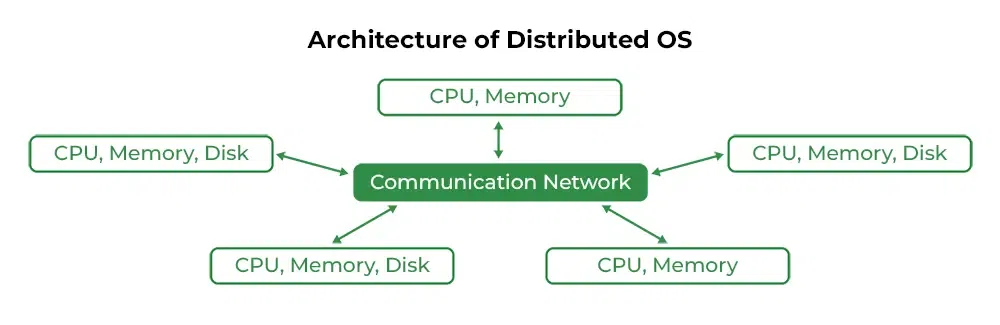
Monolithic, Micro, and hybrid kernels
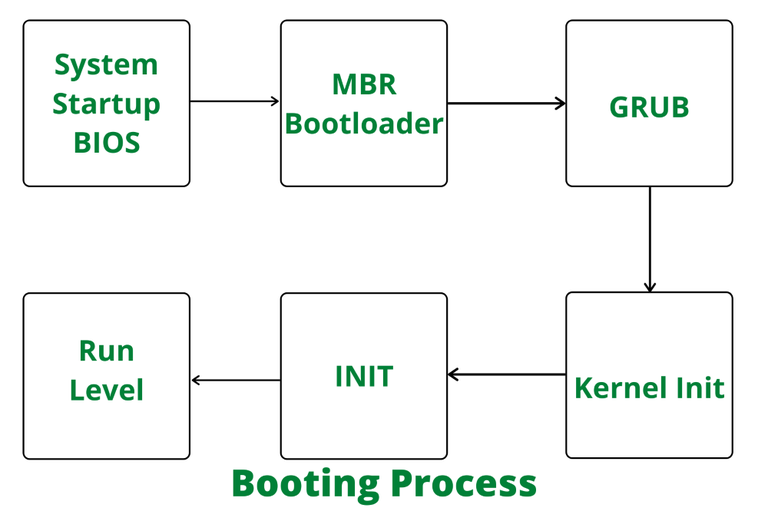
Booting Process
The program that the users interact with - Shell, GUI
Two modes of operation - Kernel mode and User mode
OS runs in kernel mode and rest of the software runs in user mode.
Kernel mode is godlike, has access to every hardware and execute any instruction that the machine is capable of.
GUI or shell is the lowest level of user mode software
OS uses software known as driver to control I/O device.
Modern operating system allow multiple programs to be in memory and run at the same time.
System Calls
🛠️ How System Calls Work: The Mechanics
- A program uses a user-mode API (e.g.,
read()) as a wrapper for a syscall. - That wrapper triggers a trap or interrupt, transitioning to kernel mode.
- The kernel decodes the syscall number (or instruction), validates parameters, and executes the service.
- Results or errors are returned to user space, and execution switches back
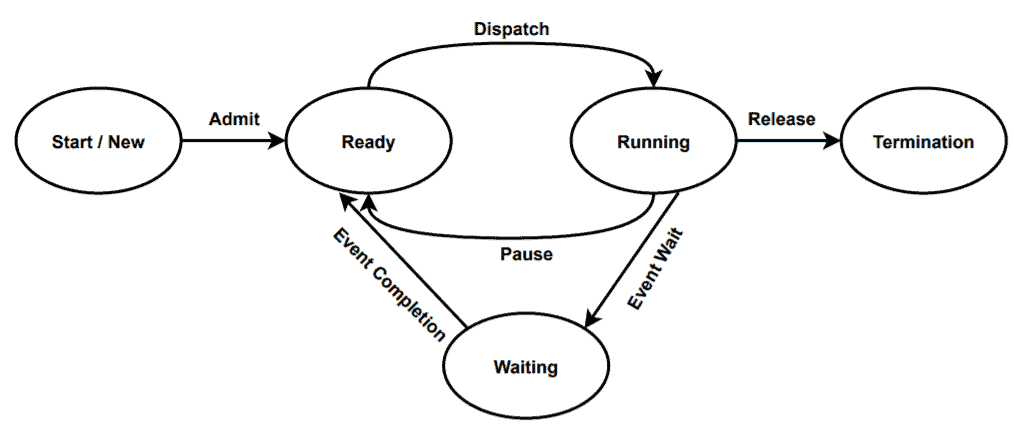
Process Lifecycle
Resource management
Multiplexing (sharing) resources in different ways - in time and in space.
Processors
The brain of the computer is CPU, it fetches instructions from memory and executes them. Each CPU has a specific set of instructions that it can execute. Thus an x86 processor cannot execute ARM programs.
The stack pointer points to the top of the current stack in memory. The stack contains one frame for each procedure that has entered not exited. A procedure's frame contains local variables, parameters that are not stored in registers.
PSW (Program status word) - contains bits to indicate the mode, control bits etc.
To obtains services from the operating system, a user program must make a system call which traps into the kernel and invokes the operating system. The trap instruction switches from the user mode into the kernel mode and once done gives the control back to user program. Other traps include division by 0 or floating point underflow etc. OS decides what to do (mafia boss)
===Multithreading - the CPU stores the states of multiple threads (a lightweight process) and switches back and forth between them.===
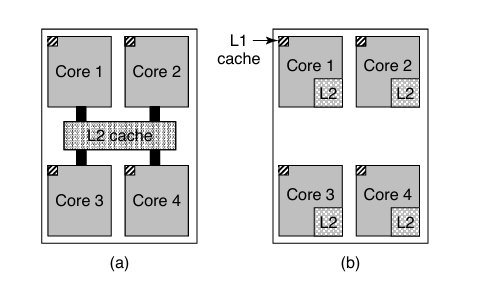
Main memory is divided into cache lines, typically 64 bytes. The most heavily cache lines are kept in a high speed cache located inside or very close the to the CPU.
CMOS stores the current date and time along with configuration parameters such as which drive to boot from.
===The software that talks to a controller giving it commands accepting responses is called device driver. ===
Device controller acts as a bridge between CPU and I/O devices, handling incoming and outgoing signals.
For device driver to work it must be put into kernel mode.
Three ways - Relink the kernel with the driver and reboot the system - Make an entry in an operating system telling it that it needs the driver and then reboot the system. - On the go
Collection of all device registers form the I/O port space
Different ways of Input and Output
- Polling - Driver continuously polls the device to see if it is done, also known as busy waiting.
- Driver starts the device and asks it to give an interrupt when it finished.
Part of the memory with addresses of interrupt handlers - interrupt vector table.
- Using DMA chip - controls the flow of bits between the memory and some controller without constant CPU intervention. The CPU sets up DMA chip with how many bytes to transfer, the device and the flow of direction and once the DMA chip is done, it calls an interrupt
Bus - path for data transfer
Booting the Computer
The flash memory in the motherboard stores the BIOS/UEFI - allows for fast booting.
After we press the power button, the motherboard waits for the signal that the power supply has been stabilized. When CPU starts executing, it fetches from a hard code physical address (known as reset vector) that is mapped to the flash memory. It executes the code from BIOS which detects and initializes the RAM, I/O devices etc.
BIOS would determine the boot device by trying a list of devices stored in CMOS memory. The first sector of the boot device is read into memory and executed (MBR), which contains a program that examines the partition table at the end of boot sector for checking the active partition of boot device. Then loads the OS from the active partition
For UEFI, checks the location of partition table in the second sector of the device. This GPT (GUID Partition Table) contains information about the location of various partitions on the disk. UEFI loads the bootloader to select the OS.
Context Switch
OS saves the process content into PCB, loads the next process's context, switches virtual address space, flushes TLB.
PCB - Identification, State, CPU context, Memory info etc.
Process Table and PCB
Process Tables maps to all active processes, pointers to PCBs.
Used for context switching, scheduling, resources sync etc.
Linux Completely Fair Scheduling
Each process has a vruntime (virtual runtime), which increases by the actual runtime * weight, weight is derived from nice value (-20 to 19). Processes with least vruntime is deemed unfairly treated and are scheduled next.
Entire setup is stored in red black tree, left most node is scheduled first.
Has dynamic time slice instead of fixed time slice like round robin
Arrival Time - When a process enters the ready queue
Burst Time - CPU time required by the process
Waiting Time - Time spent waiting
Turnaround Time - Time from arrival to completion
Response Time - First execution - arrival
FCFS, SJF, PS, RR, Multilevel Queue, Multilevel Feedback Queue
Concurrency
Thread is a lightweight process that may be a part of a larger program. It is the smallest unit of execution
- Its own program counter
- Register set
- Stack
- Execution metadata
In a multi threaded program, there are more than one point of execution.
State of a single thread is similar to that of a process, it has a program counter that tracks where the program is fetching the instructions from and a private set of registers.
If there are two threads that are running on a single processor, when switching from T1 to T2, context switch must take place.
Threads share the same address space.
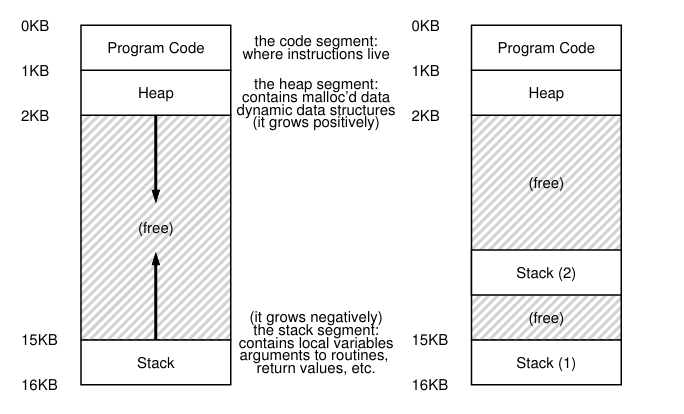
Why use threads - parallelism, efficiency
TCB
- Thread ID
- Stack pointer, program counter
- Thread state
- Pointer to PCB
===A crash of a thread will affect others due to sharing of address space===
- Concurrency vs Parallelism
#include<stdio.h>
#include<assert.h>
#include<pthread.h>
#include "common.h"
#include "common_threads.h"

void *mythread() {
    printf("Hello there\n");
    return NULL;
}

int main(int argc, char* argv[]) {
    pthread p1, p2;
    int rc'
    Pthread_create(&p1, NULL, mythread, NULL);
    Pthread_create(&p2, NULL, mythread, NULL);
    Pthread_join(p1, NULL);
    Pthread_join(p2, NULL);
    return 0;
}
Race Conditions
When multiple threads try to update a shared variable simultaneously the final result may be incorrect due to overlapping operations.
updating a variable is not atomic - Reading the value of counter from memory - Incrementing the value - Writing the value back to memory If context switch happens between these steps another thread may overwrite the value
Thread1 - Read Counter(50) -> Increment (51) -> Interrupt Thread2 - Read Counter(50) -> Increment(51) -> Write (counter=51) Thread1: Write (counter = 51e)
One way to avoid this
Disable interrupt (Masking of Interrupts)
void lock() {
    DisableInterrupts
}
void unlock(){
    EnableInterrupts
}
# Load and store solution
typedef struct __lock_t{
    int flag;
}lock_t;
void init(lock_t *mutex) {
    mutex->flag = 0;
}
void lock(lock_t *mutex) {
    while(mutex->flag == 1); (spin-wait)
    mutex->flag = 1;
}
void unlock(lock_t *mutex) {
    mutex->flag = 0;
}
/*
Race condition in lock()
Thread A reads flag == 0
Context switch Thread B flag == 0
Critical Section

Busy Waiting (Spin Waiting)

Doesnt work on Multiprocessors
*/
Solution - Use a lock
Use a variable to implement the mutually exclusive access to critical section
pthread_mutex_t lock = PTHREAD_MUTEX_INITIALIZER;
pthread_mutex_lock(&lock);
counter = counter+1;
pthread_mutex_unlock(&lock);
pthread_mutex_t lock = PTHREAD_MUTEX_INITIALIZER;
int counter = 0;
void *increment(void *arg) {
    pthread_mutex_lock(&lock);pthread
    counter++;
    pthread_mutex_unlock(&lock);
    return NULL;
}
int main() {
    pthread_mutex_init(&lock, NULL);
    pthread_t t1,t2;
    pthread_create(&t1, NULL, increment, NULL);
    pthread_create(&t1, NULL, increment, NULL);
    pthread_join(t1, NULL);
    pthread_join(t2, NULL);
    pthread_mutex_destroy(&lock);
    return 0;
}
- Mutual Exclusion
- Fairness
- Performance - if many threads frequently request a lock, performance drops as mutex operations are expensive.
- Starvation - Occurs when a thread never gets a chance to acquire a lock due to other threads constantly locking it.
Deadlock
Occurs when two or more threads wait indefinitely for each other to release a lock
thread1 locks lock1, then waits for lock2
thread2 locks lock2, then waits for lock1
Always lock in a consistent order
Use try-lock pthread_mutex_trylock() so that thread can exit gracefully if fails.
Four Conditions
(MHNC) - Mutual Exclusion - Hold and Wait - No Premption - Circular Wait
DeadLock Prevention
Prevent hold & wait as well as circular wait
DeadLock Avoidance
Banker's Algorithm - Only provides resources if the resultant goes into a safe state
Detection and Recovery
Process Kill, resource preemption, ostrich algorithm
What is a Spinlock?
A spinlock is a type of lock mechanism used in multi-threaded programming where a thread continuously "spins" (busy-waits) until it acquires the lock.
Unlike mutexes, which block the thread and put it to sleep if the lock is unavailable, a spinlock keeps checking the lock in a loop until it becomes free.
1. How Spinlocks Work
A spinlock is typically implemented using atomic operations like:
- Test-and-Set (TAS)
- Compare-and-Swap (CAS)
- Load-Linked/Store-Conditional (LL/SC)
Test and Set (Hardware Primitive)
int TestAndSet(int *old_ptr, int new) {
    int old = *old_ptr;
    *old_ptr = new;
    return old;
}

void lock(lock_t *lock) {
    while(TestAndSet(&lock->flag, 1) == 1);
}
Compare and Swap (Hardware Primitive)
void lock(lock_t *lock) {
    while(CompareAndSwap(&lock->flag, 0, 1) == 1);
}
Load-linked and store conditional (Lock free synchronization)
Load-Linked (LL) and Store-Conditional (SC) are atomic instructions used in multiprocessor systems to implement lock-free synchronization. These instructions ensure that updates to a shared variable happen atomically without using locks.
Load-linked - Reads a value from memory and monitors it for changes
Store conditional - Stores a new value only if no other thread modified it.
int LoadLinked *ptr{
    return *ptr;
}

int storeConditional(int *ptr, int value) {
    # if no update to *ptr since LL to this addr
    *ptr = value;
    return 1; // Success
    else return 0;
}

void lock(lock_t *lock) {
        while(1) {
            while(LoadLinked(&lock->flag) == 1);
            if(StoreConditional(&lock->flag, 1) == 1)
            return;
         }
}
Fetch and Add (Ticket Lock)
- Fetches the current value of a shared variable
- increments the value atomically
- returns the old value before addition.
Kind of turn based system, every thread gets the lock somehow (fairness brrr)
int FetchAndAdd(int *ptr) {
    int old = *ptr;
    *ptr = old + 1;
    return old;
}
typedef struct __lock_t{
    int ticket;
    int turn;
} lock_t;

void lock_init(lock_t *lock) {
    lock->ticket = 0;
    lock->turn = 0;
}

void lock(lock_t *lock) {
    int myturn = FetchAndAdd(&lock->ticket);
    while(lock->turn != myturn);

}
void unlock(lock_t *lock) {
    lock->turn += 1;
}
To much spinning for the above methods
Yield to avoid spinning
void init() {
    flag = 0;
}

void lock() {
    while(TestAndSet(flag, 1) == 1)
        yield() // give up the cpu
}
- Can cause starvation
- Context switch cost
Previous methods can cause starvation (either yield of spin-wait)
Using queues to avoid spinning
- Sleeping instead of spinning
- If a process finds that the lock is currently held by another process
- It will be added to a queue of waiting threads
- Then it will be put to sleep by park() system call
-
unpark() wakes it up and lock is transferred
-
Guard lock - a spin lock used to only protect modifications to flag and queue
- Queue
- Flag - indicates whether the lock is held
typedef struct __lock_t {
    int flag;
    int guard;
    queue_t *q;
}lock_t;

void lock(lock_t *m) {
    while(TestAndSet(m->guard, 1) == 1); // acquire guard lock, if 0, modifications for other threads not allowed
    if(m->flag == 0) { // acquires the lock
        m->flag = 1;
        m->guard = 0;
    } else {
        queue_add(m->q, gettid());
        m->guard = 0;
        park();
    }
}

void unlock(lock_t *m) {
    while(TestAndSet(&m->guard, 1));
    if(queue_empty(m->q)) {
        m->flag = 0; // release the lock
    } else unpark(queue_remove(m->q));
    m->guard = 0;
}

typedef struct __lock_t {
    int flag;
    int guard;
    queue_t* q;
}lock_t;

void lock(lock_t* m) {
     while(TestAndSet(m->guard, 1) == 1);
     if(m->flag == 0) {
        m->flag = 1;
        m->guard = 0;
    } else {
        queue_add(m->q, gettid());
        m->guard = 0;
        park();
    }
}

void unlock(lock_t* m) {
    while(TestAndSet(&m->guard, 1));
    if(queue_empty(m->q)) {
        m->flag = 0;
    } else unpark(queue_remove(m->q));
    m->guard = 0;
}
Linux Futex (Fast User-space mutexes)
Provide efficient thread synchronization by allowing threads to sleep and wake up in user space without frequent system calls.
void mutex_lock(int *mutex) {
    int v;
    // check 31st bit
    if(atomic_bit_test_set(mutex, 31) == 0) return;
    atomic_increment(mutex);
    v = *mutex;
    while(1) {
        if(atomic_bit_test_set(mutex, 31) == 0) {
            atomic_decrement(mutex);
            return;
        }
        v = *mutex;
        if(v >= 0) {
            continue;
        }
        futex_wait(mutex, v);
    }
    void mutex_unlock(int *mutex) {
        if(atomic_add_zero(mutex, 0x80000000)) return;
        futex_wake(mutex);
    }
}
Semaphore = (Conditional Variables + mutual exclusion)
Scheduling Algorithm
Pre-emptive - A process can go from running queue to ready queue in the middle of execution
Non pre-emptive - Process has to be completed no matter what
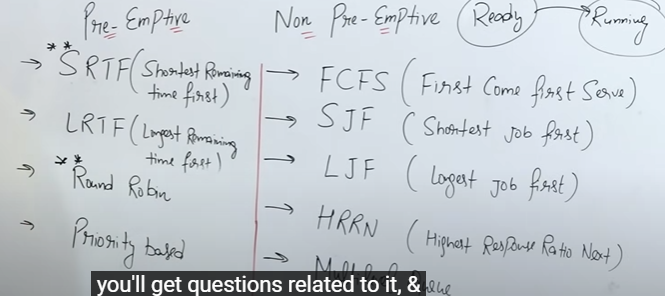
Priority can be pre-emptive or non pre-emptive
CPU Parameters
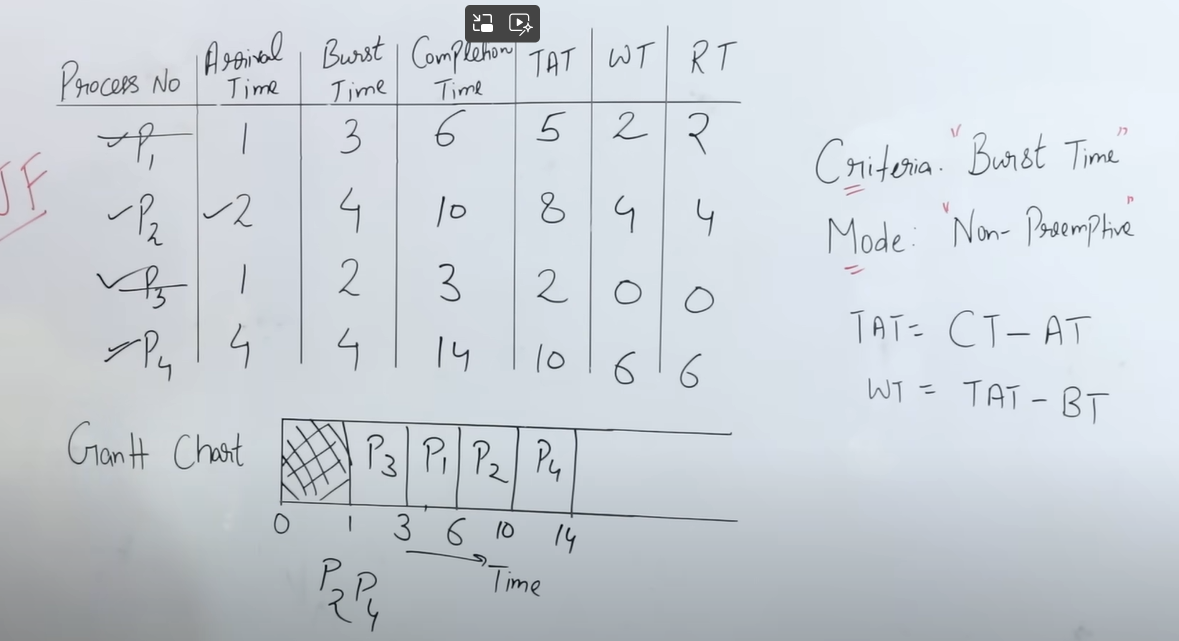
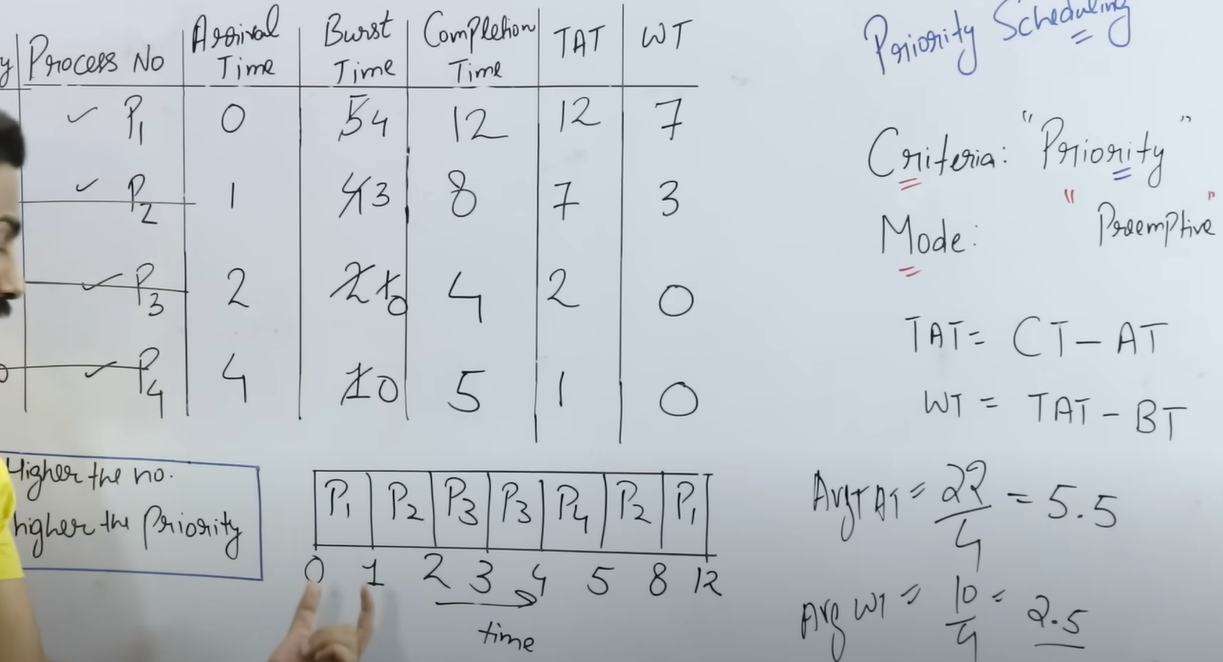
Arrival time - time to arrive Burst time - time to execute Completion time - point of time for completion Turn around time - completion time - arrival time Waiting time - Turn around time - Burst time Response time - (The time at which a process gets CPU first time) - arrival time
===In non pre-emptive, response time = waiting time
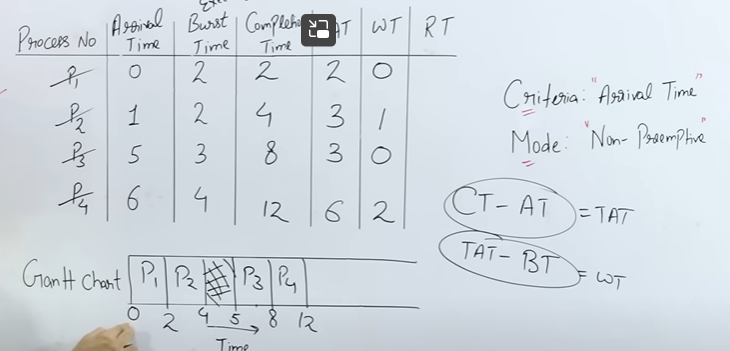
Shortest Job First
Priority Scheduling with Pre-emption
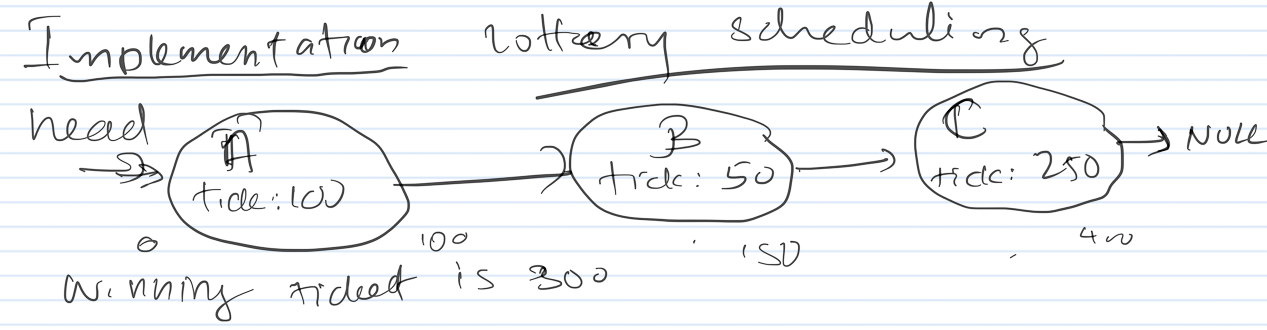
Lottery Scheduling in Operating System
- Can be pre-emptive or non pre-emptive
- Probabilistic method ===Ways to manipulate tickets===
Scheduler gives a certain number of tickets to different users in a currency and users can give it to their process in different currency. Eg A - 100, B - 200. The given tickets are converted into global currency at the time of execution.
A process can pass its tickets to another process (client - server)
In this way a process can temporarily raise or lower the number of tickets in owns
- Fairness - less chance of starvation - completely random
-
Flexibility
-
An attacker can manipulate the scheduling algorithm
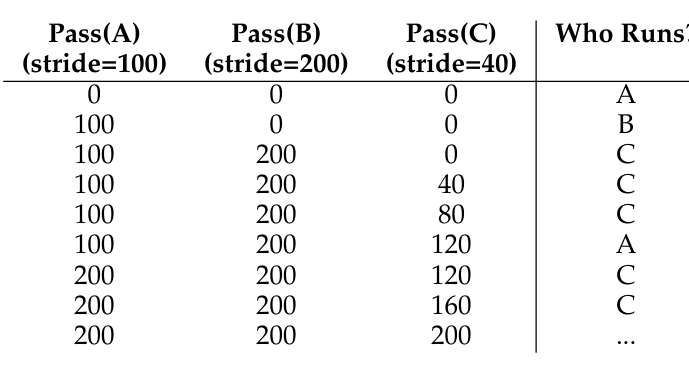
Stride Scheduling
Linux Completely Fair Scheduler (CFS)
The CFS is designed to ensure that all the tasks gets a fair share of CPU time, instead of relying on a fixed time slices.
- No need to fixed time slices
- No need of priority boosting
CFS removes the time slices and instead tracks how much time each task has received ensuring fairness
CFS maintains a vruntime for each process, lowest being highest priority (left node of Red Black Tree)
When a task finishes running, it is reinserted based on update vruntime
Only for extra knowledge
vuntime += actual runtime * load weight / nice value weight
The nice value affects the weight of the process (-20 to +19)
nice value 0 -> weight 1024 nice value +5 -> weight < 1024 else weight > 1024
High Memory (User Space)
┌────────────────────────┐
│ User Stack (grows down) │ <-- Used for function calls, local variables
│ │
│ │
│ Heap (grows up) │ <-- Used for dynamic allocations (malloc, new)
│ │
│ │
│ Data Segment │ <-- Stores global/static variables
│ │
│ Code (Text Segment) │ <-- Stores machine instructions
├────────────────────────┤
│ Kernel Stack (per-process) │ <-- Used when the process is in kernel mode
├────────────────────────┤
│ Kernel Space (Shared) │ <-- Contains OS code and data structures
└────────────────────────┘
Low Memory (Kernel Space)
Kernal stack - stores process details when switched to kernel mode, stores system calls, exceptions, interrupts, return address, saved registers etc.
Concurrency Race Condition Need for synchronization Atomicity
Vasu's sir portions
Initial setup
Base and bound pairs for each cpu for allocating the space in the memory for the processes
Also known as dynamic relocation
Not flexible No dynamic growth of stack and heap Context switch is difficult Contigous allocation
Basic page replacement Optimal LRU - counter and stack LRU approximation - Clock algorithm - Second chance and enhanced second chance
Counter based buddy system
FCFS SSTF SCAN LOOK C-SCAN C-LOOK
Name Extension Size Location Identifier Created Date Protection Encryption
Conditional Variables are a way for the threads to communicate with each other
pthread_mutex_t mutex = PTHREAD_MUTEX_INITIALIZER;
pthread_cond_t full = PTHREAD_COND_INITIALIZER;
pthread_cond_t empty = PTHREAD_COND_INITIALIZER;

void* producer(void* arg) {
    for(int i = 0; i < 10; i++) {
        pthread_mutex_lock(&mutex);
        while(count == BUFFER_SIZE) {
            pthread_cond_wait(&empty, &mutex); // waiting to receive the signal
        }
    buffer[count] = i;
    count++
    pthread_cond_signal(&full); // signalling there is atleast one item in the buffer
    pthread_mutex_unlock(&mutex);
    }

}

void* consumer(void* arg) {
    for (int i = 0; i < 10; i++) {
        pthread_mutex_lock(&mutex);  // Lock before accessing shared resource

        // Wait if the buffer is empty
        while (count == 0) {
            printf("Buffer is empty, consumer is waiting...\n");
            pthread_cond_wait(&full, &mutex);  // Wait for a producer to add an item
        }

        // Remove an item from the buffer
        count--;
        int item = buffer[count];
        printf("Consumed item: %d\n", item);

        // Signal the producer that there is space in the buffer
        pthread_cond_signal(&empty);

        pthread_mutex_unlock(&mutex);  // Unlock after done
    }
int main() {
    pthread_t prod, cons;
    pthread_create(&prod, NULL, producer, NULL);
    pthread_create(&cons, NULL, consumer, NULL);
    pthread_join(prod, NULL);
    pthread_join(cons, NULL);

}
A semaphore is a synchronization primitive used to manage access to shared resources in concurrent programming. It is primarily used to solve problems where multiple processes or threads need to share resources but need to be controlled to avoid conflicts and ensure proper execution.
Analogy
Imagine a parking lot with 3 spots (semaphore value = 3):
-
When a car enters, it calls
wait(), reducing available spots. -
When a car exits, it calls
signal(), increasing available spots. -
If the lot is full (semaphore = 0), incoming cars must wait.
-
As soon as one car leaves and does
signal(), a waiting car is allowed in.
Producer Consumer Problem
Producer must not push to filled buffer, and consumer may not take from empty buffer
Counting semaphore / Binary Semaphore
pthread_cond empty = N
pthread_cond full = 0
pthread_mutex lock

# Producer

Producer() {
    // produces something
    wait(empty)
    lock(mutex)
    // add to the buffer
    unlock(mutex)
    signal(mutex)
}

Consumer() {
    wait(full)
    lock(mutex)
    // take from the buffer
    unlock(mutex)
    signal(empty)
}
Readers-Writers Problem
Multiple readers can access it and writers get exclusive access
Writer Preference, Reader Preference
Fair version - make them line up
Dining Philosopher
Prevention
Restrict Entry to N-1 (Atleast 1 get two forks) Odd/Even Three states - THINKING, HUNGRY, EATING
Memory Management
Contiguous Memory Allocation (Fixed and Dynamic)
Fixed partitions -suffers internal fragmentation Dynamic partitions - Variable sized allocation - reduces internal but sufffers external
Non Contiguous Allocation - Paging and Segmentation
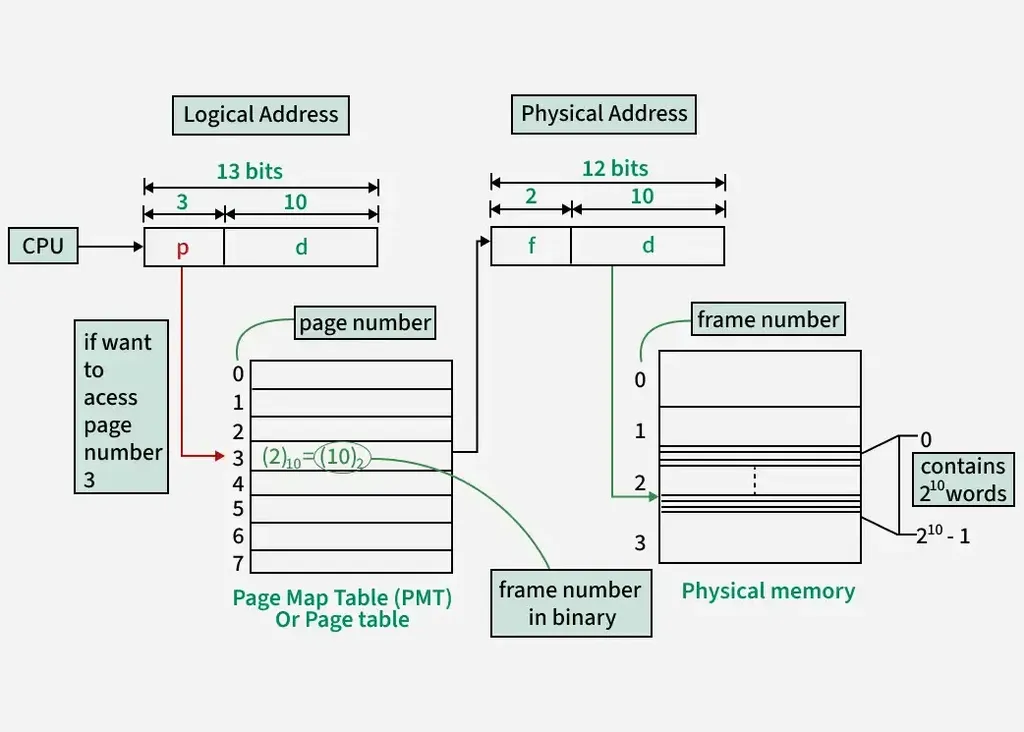
Memory divided into fixed size pages and physical memory into frames.
Each process has a page table
MMU - translation, using a translation lookup buffer
May incur internal fragmentation
Segmentation
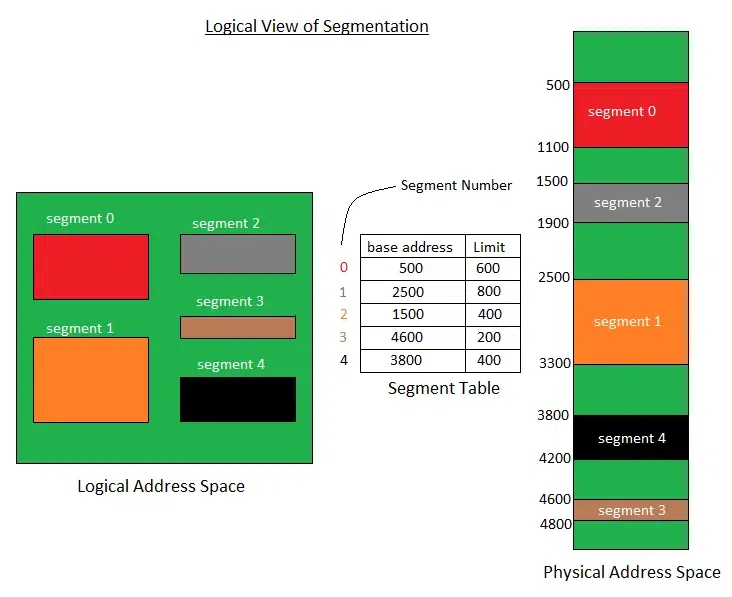
Divides memory into variable sized segments aligned with local divisions
Segment tables map logical segments to physical addresses.
Suffers from external fragmentation
Segmented Paging - Modern
Swapping and Virtual Memory
Swapping - moves processes between RAM and disk to free space for others.
Virtual Memory uses both paging and swapping
Thrashing - frequent page faults.
Loading & Linking - static and dynamic
Data Structures
Partition Tables, Page Table, Segment Table
Virtual Memory
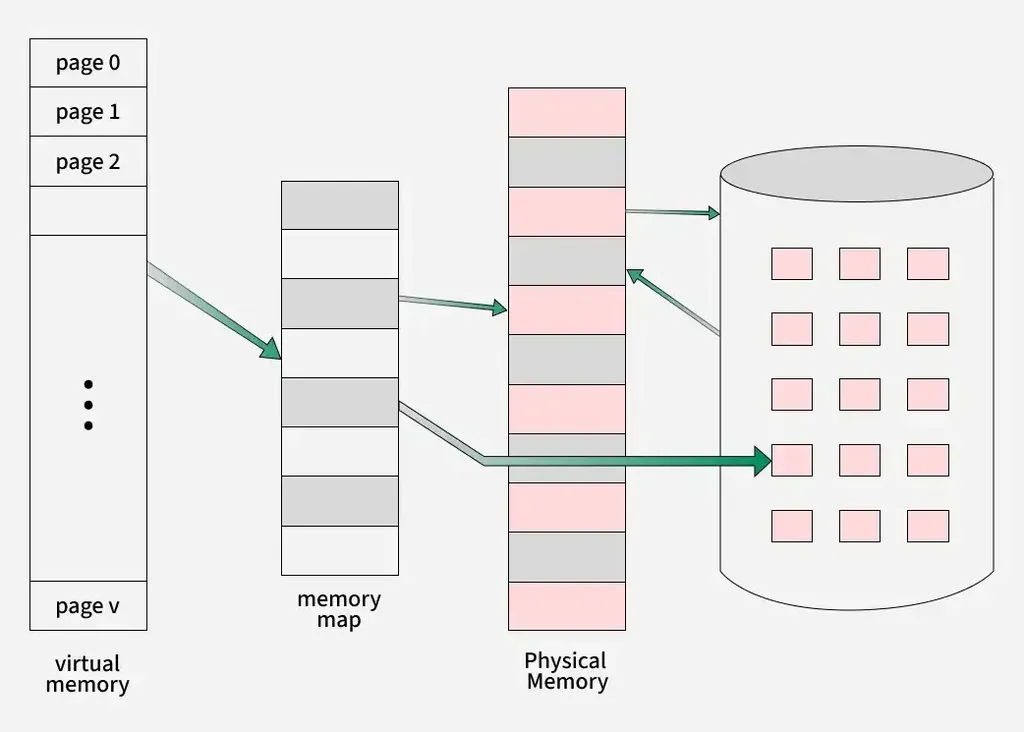
Page Replacement Techniques
FIFO, LIFO, Optimal, LRU, Clock
File Allocation Techniques
Continuous Allocation Linked Allocation Indexed Allocation
Paging - Hierarchical, Hashed, Inverted
Index Node
Stores the metadata for each file in Linux Uses filename to get the node, which in turn gives the pointers to the data blocks
block[0..11] → Direct pointers to 12 blocks block[12] → Single Indirect (pointer to a block of pointers) block[13] → Double Indirect (pointer to block → pointer to block → data) block[14] → Triple Indirect (3 levels of indirection)